


Knitting Bestway 913 'A Jumper Threaded with Colour' from the 1940s - plus free pattern

This is another beautiful 1940s pattern from my own collection and the third vintage knit I sized up for myself.
Though the design looks complicated, the whole jumper is knitted in moss stitch, and the criss-cross pattern is achieved by threading the coloured yarn through the purl stitches.

The pattern asks for UK no.9 needles which in metric 3.75mm needles, and originally uses 3 ply yarn, but based on the needle size and tension given, I bought a 4 ply cone of lambswool from www.yarnoncone.co.uk .
The criss-cross detail was done in green and red in the pattern, so sticking to the same colours I bought a 50g ball of each in cotton from Abakhan's, as I liked the sheen as a contrast against the cream wool.

After sizing up the pattern from 34-36 inch bust to 43 inch,
(tips on how to size up vintage patterns can be found here Sizing up vintage knitting patterns - My own experience) I knitted a couple of rows to make sure it matched the tension as given in the pattern.
As I was so used to knitting a k1, p1 rib waistband in previous projects, it felt odd to go straight into moss stitch, and always had to check whether it was a knit or purl stitch first each row so I didn't accidentally do a rib row in the middle of the moss stitch.
After knitting all the pieces, it was time to start darning or threading the different colours.
I used stitch markers to mark the first and last purl stitch on the first row as specified in the pattern.

Using a large yarn or wool needle, I threaded green cotton yarn diagonally through the purl stitches. Because I wasn't sure how much to use and wanted to make sure there was still room for the jumper to stretch when worn, I didn't cut the yarn until I had threaded across the full front and left enough spare length at either end for knotting or tying before cutting it off from the ball.
I threaded all the green lines from right to left first, before moving onto the red, which was the next row directly below.
The pattern stated that there had to be 11 diagonal purl rows between the two darned rows, so I counted 13 between the green rows before threading red on the 12th rows. On several occasions I did miscount, but could just pull the yarn out and start again.
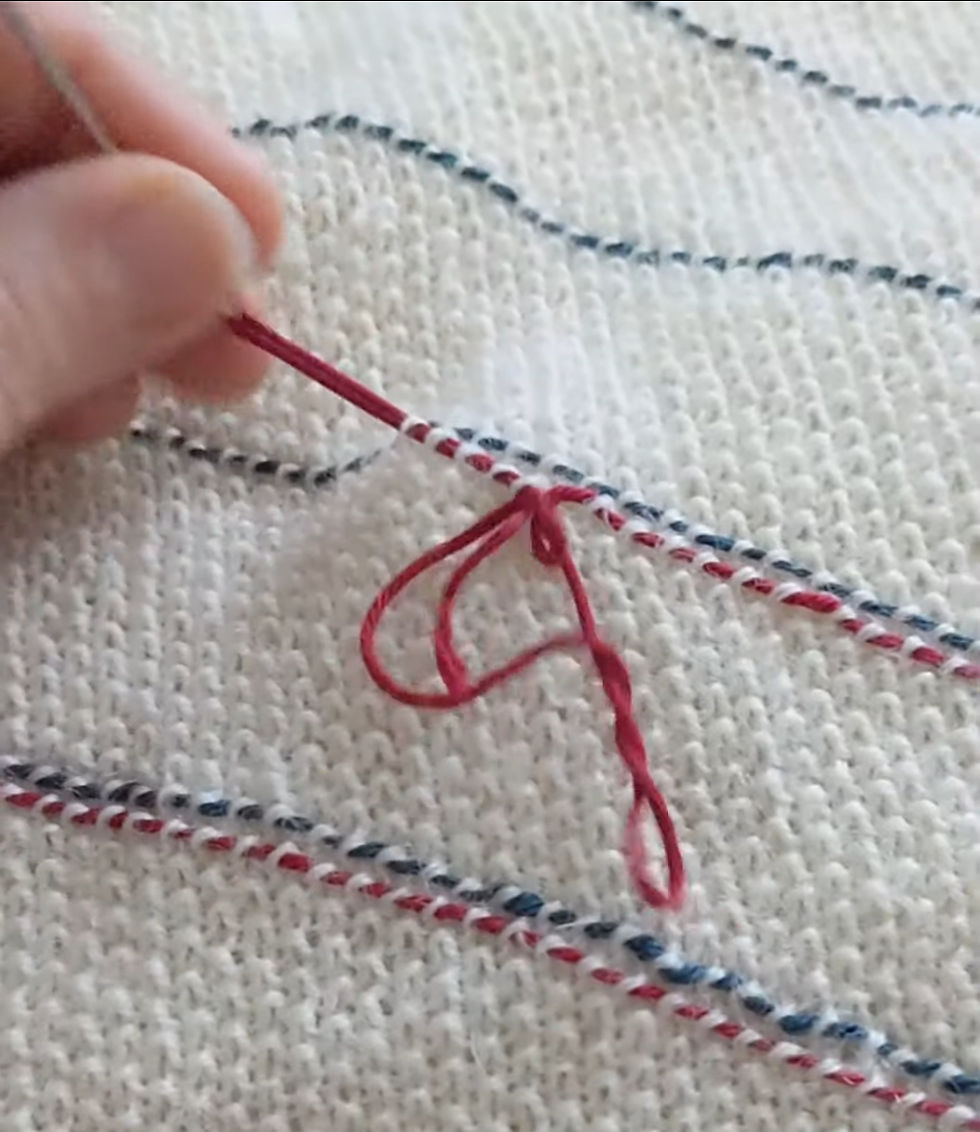
Darning all the pieces like this felt like it took as long as it did to knit the entire thing, but the result in the end was worth it.
This technique would be great for using up oddments of wool on plain jumpers.

The pattern never specified how the darned ends were to be secured at the hem of the jumper. Tying a knot would make it bulky, so I decided to darn the ends on the inside as well, following the same direction as the right side rows.
On the sides I knotted the ends together and then sewed up the seams to make sure they wouldn't be able to come undone.


Pattern asks for crochet loops for the buttons, however I can't crochet, so I knitted a button hole placket instead. I measured out where the buttons were to go and used stitch markers at either end to use as a guide when making the placket, to make sure it was the right length.

The buttons in the pattern were also crocheted in green yarn. I checked my button stash for green and red buttons and found the red ones as pictured above that were the right size for the buttonholes.

As well as increasing the width of the main body of the jumper, I also increased the sleeve width. However my calculations were off on the upper arm, so I added a pleat or dart to make it fit better when worn. Thankfully I was able to make it look like it was part of the design, and gave a more interesting shape to the sleeve.

Even though they are not mentioned in the original pattern, I knitted up some shoulder pads to give the sleeve heads a little structure and add to the 1940s look. To make the shoulder pad, I just knitted a square in garter stitch, folded it in half to make a triangle, sewing the sides together, and sewed the long edge to the seam at the top of the sleeve where it meets the shoulder seam.
You can watch how I made this jumper on my YouTube channel and on TikTok.
Bestway no. 913 'A Jumper Threaded With Colour'
This adorable jumper will fit 34-36 inch bust sizes.
Materials required:
Seven ounces of 'Sirdar' Super Shetland Wool, 3 ply in white.
1/2 ounce each in red and green.
A pair of no.9 knitting needles.
A fine crochet hook and a little cotton wool (for the buttons).
Tension:
15 sts to 2 inches in width and 11 rows to 1 inch in depth. (It is important to work to this tension.)
Measurements (after pressing):
Length from lower edge to top of shoulder, 19 1/2 inches; length of sleeve along seam, 4 1/2 inches. To fit 34-36 inch bust.
Abbreviations:
St(s) - Stitch(es); k - knit; p - purl; tog - together; rep - repeat; rem - remain/s/der/ing; inc - increase(ing); dec - decrease(ing); dc - double crochet; ch - chain; m-st - moss st.
To dec 1 st take 2 sts tog. To inc 1 st, work into the back as well as the front of same st before you slip it off left hand needle.
The Back and Front (Both alike)
Using white wool, cast on 105 sts and work in m-st as follows:
1st Row: K 1 *P1, K1; rep from * to end.
Continue to rep this row, but before going further, mark the first and last p st of 1st row with a coloured thread, as a guide to starting the darning later on. These p sts will be the second st from each end of work. When you have completed 30 rows, proceed, keeping the continuity of m-st patterning, but inc 1 st at both ends of the next row, and similarly every following 8th row until there are 113 sts, then every 6th row until there are 133 sts.
Work 21 rows more.
Now shape the armholes: Cast off 3 sts at the beginning of each of the next 6 rows, then k2tog at the start of every row until 93 sts rem. Work 42 rows more.
Now shape the shoulders: Cast off 9 sts at the beginning of each of the next 6 rows (39 sts). Work straight fro 10 more rows on these 39 sts. Cast off.
The Sleeves (Both alike)
Cast on 93 sts and work for 46 rows in m-st, marking 11th p st from each end of 1st row with coloured thread.
Now shape the top. K2tog at the end of every row until 51 sts rem. Work for 22 sts more. Cast off 17 sts at the beginning of each of the next 2 rows. (17 sts)
Work for 17 rows more on these 17 sts. Cast off.
Work another sleeve to match.
The Buttons (three alike)
With the crochet hook, work 4 ch in the green wool and fasten to form a ring, into which work 10 d.c. Working d.c over d.c, work 20 more d.c, then insert a tuft of cotton wool and cover by working d.c into every alternate d.c until closed. Fasten off. Make two more buttons in the same way.
The Making Up
Carefully press all the pieces with a hot iron over a damp cloth.
To work the darning for the plaid patterning, place front of jumper on table in front of you, with side edges to right and left and waist edge towards you.
Using green wool and beginning at marked st at bottom of right hand corner, proceed to darn through every p st diagonally towards the left, continuing until you have reached the left side edge, an inch or two below armhole. Then with red wool, darn through the next diagonal of p sts immediately on left. Rep these two diagonal lines of darning slanting from right to left, 3 times more, each time starting from lower edge and leaving 11 diagonal lines of purl clear between them.
When these other three plaid lines are finished, proceed to darn the remainder of front in same way, but starting from right side edge and, later from right armhole edge, remembering that there must be 11 diagonal lines of purl left clear between one double line of darning and the next one above it.
This time too, you should commence with red thread, and work the green thread through on next diagonal line of darning immediately above.
When all the front has been worked over like this, commence at marked st at bottom left hand corner of waist and add diagonal lines of darning to slant in the opposite direction. In working these double lines, begin any which start from the waist with green and put the red thread immediately on the right side of it.
Darn the back of the jumper to match, then darn the sleeves in the same way, commencing at the marked st on right of lower edge, and then darning across the other way from marked st on left.
Sew up one shoulder, and on the second shoulder, beginning at the armhole edge, seam up the first 18 sts only.
Along one edge of this opening work 3 rows of d.c, along the opposite side work 1 row d.c, then a second row in which work three loops to serve as buttonholes.
Sew the outer edges of the small tab at top of sleeve to the cast off edges and neatly sew the tops of sleeves into armholes. Sew up remaining seams and press. Sew on buttons.


